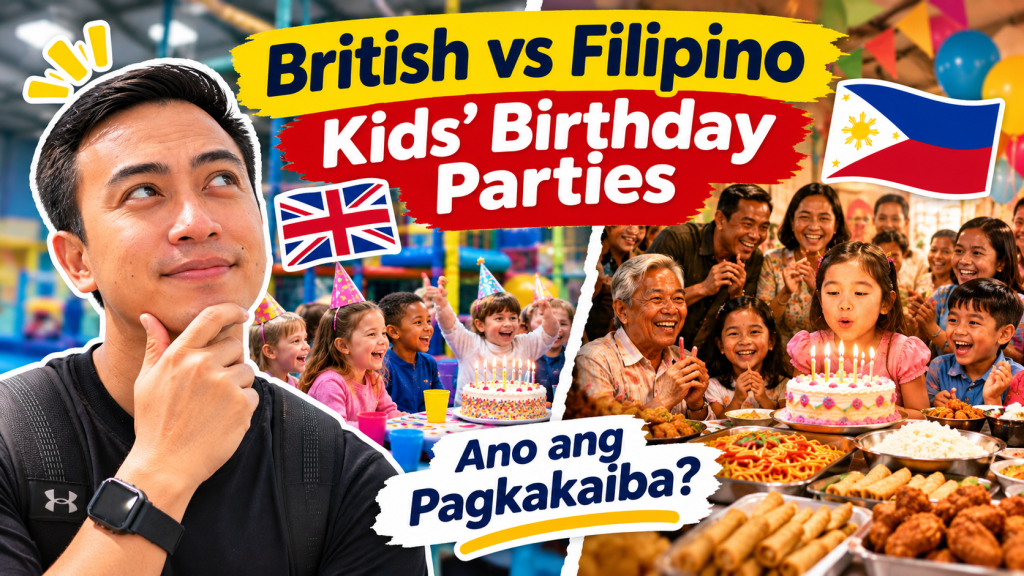
Since Ate started Reception here in the UK, we’ve entered another stage of parenting.
Birthday party invitations!
At first, I thought, okay, another birthday party. We buy a present, attend the celebration, and go home.
But as we started receiving invitations from her classmates, I realised how different British kids’ birthday parties are compared to the ones I grew up with in the Philippines.
And honestly, some of these differences are quite funny.
1. In the Philippines, “Punta Kayo” Means the Whole Family
Growing up in the Philippines, when someone invites you to a birthday party and says, “Birthday ng anak ko sa Saturday. Punta kayo,” we usually understand it as an invitation for the family.
Nanay, Tatay, mga anak, sometimes even grandparents and cousins.
Basta, sama-sama!
Here in the UK, things work differently.
If the invitation has Ate’s name on it, usually, Ate is the one invited.
Not necessarily Nanay, Tatay, or Bunso.
Sorry, Bunso. Kahit kapatid ka, hindi automatic na kasama ka sa guest list!
Of course, parents often accompany younger children, depending on the venue and the host’s arrangements.
It’s a small cultural difference, but something Filipino parents need to get used to.
2. British Birthday Parties Have a Schedule
One thing I appreciate about British kids’ birthday parties is how organised they are.
The invitation normally includes the date, venue, start time, finish time, and RSVP details.
Sometimes, parents also ask about allergies or dietary requirements.
And yes, you need to confirm whether your child is attending.
Most of the parties we’ve encountered are planned for around two hours.
For example, 2 PM to 4 PM.
At 4 PM, the party finishes.
Thank you for coming. See you at school on Monday!
Now compare this with a typical Filipino birthday celebration.
Ano ba ang finish time?
Usually, wala!
Even after the children finish playing, the adults are still sitting around, chatting, drinking coffee, and eating another round of food.
Minsan, may naglalabas pa ng additional pagkain.
In the UK, the schedule is clear. In the Philippines, the celebration often continues while everyone is enjoying themselves.
Both have their advantages.
3. The Birthday Present Dilemma
Here’s another challenge I wasn’t expecting.
Buying presents for children I barely know.
Ate talks about her classmates at home, but most of the time, we only know their names.
So I asked her:
“What does your friend like?”
“I don’t know.”
“Does she like dolls?”
“I don’t know.”
“Arts and crafts?”
“I don’t know.”
Okay, Ate. Thank you for the useful information!
Now Tatay is standing in a toy shop trying to choose a present for a four or five-year-old child.
Then come the questions.
How much should we spend? What present is appropriate? Do we need a birthday card? Should Ate write her own message?
Suddenly, birthday invitations become another parenting responsibility.
RSVP, buy the present, prepare the card, remember the date, and arrive on time.
Welcome to another stage of parenting!
4. Soft Play vs Filipino Birthday Celebrations
Here in the UK, children’s birthday parties often take place at soft-play centres, trampoline parks, bowling centres, activity venues, or community halls.
The setup is practical.
Children arrive, play, eat, sing Happy Birthday, enjoy some cake, and go home.
The activities are usually the main attraction.
In the Philippines, a children’s birthday party often feels like a family reunion.
You have the birthday child, classmates, cousins, grandparents, titos, titas, neighbours, and family friends.
Sometimes, you meet someone at the party and wonder who invited them.
But they’re already there, enjoying the food.
So welcome to the party!
And speaking of food…
5. Filipino Birthday Parties and Our Love for Food
Let’s talk about one of the biggest differences.
The food.
In the Philippines, a child might be celebrating their fourth birthday, but the food looks like it’s prepared for a much bigger event.
Spaghetti, pancit, lumpia, fried chicken, barbecue, rice, cake, and desserts.
And yes, rice!
Because somehow, even at a children’s birthday party, Filipinos still need rice.
There’s also an unwritten rule among Filipino families.
Mas okay nang sobra ang pagkain kaysa kulang.
If you’re expecting thirty guests, prepare enough food for fifty!
We want everyone to eat well, and ideally, have something to take home.
British children’s parties tend to have a simpler food setup, often with sandwiches, pizza, snacks, fruit, drinks, and birthday cake.
Different approaches, but both are ways of celebrating our children.
6. Party Bags vs “Mag-Sharon Ka!”
Another British birthday tradition I’ve learned about is the party bag.
Children arrive with a birthday present, but when they leave, they often receive a small bag containing sweets, stickers, bubbles, little toys, or sometimes a slice of birthday cake.
It’s a nice gesture from the birthday child’s family.
But when I first encountered this tradition, I thought…
Wait, Filipinos have something similar!
We call it “Mag-Sharon ka!”
Except our version is slightly different.
Instead of sweets and stickers, you might go home with spaghetti, pancit, lumpia, fried chicken, and cake.
Sometimes, may lunch ka na for the following day!
Different cultures, same ending.
Nobody goes home empty-handed.
7. Watching Our Children Build Their Own Friendships
Beyond the cultural differences, there’s something I appreciate about receiving these birthday invitations.
It’s seeing Ate develop her own friendships.
At home, she talks about her classmates.
“My friend did this.”
“My friend said this.”
“I played with my friend today.”
And as parents, we hear these names without knowing exactly who they are.
Then we attend a birthday party and finally meet them.
Ah, so ikaw pala yung lagi niyang kinukuwento!
It’s interesting seeing your child interact with other children outside your home.
You see who she plays with, who she talks to, and how she behaves around her friends.
And then you realise something.
Lumalaki na talaga sila.
A few years ago, Ate’s world was mostly Nanay and Tatay.
Then Bunso arrived.
Now there’s school, teachers, classmates, friends, and birthday invitations.
She’s slowly building her own social life and creating memories outside our family.
As a dad, I’m happy seeing her grow, although there’s also a little sadness knowing how quickly time passes.
8. Raising Filipino Children With Two Cultures
One of the things I appreciate about raising our children in the UK is their exposure to two cultures.
At home, they experience our Filipino traditions, food, language, and family gatherings.
Outside, especially at school, they experience British traditions through their classmates and friends.
And through these experiences, Nanay and Tatay are learning too.
Our children are growing up with British culture, while we’re still getting familiar with some of its traditions.
One weekend, we might attend a two-hour birthday party at a soft-play centre.
Then when it’s our turn to celebrate our children’s birthdays, knowing us Filipino parents, good luck keeping it to two hours!
There will still be spaghetti, lumpia, fried chicken, rice, and enough food for everyone to take home.
Some traditions will always be part of our family.
Final Thoughts From Tatay
What started as a simple birthday invitation became another learning experience for me as a Filipino parent in the UK.
From RSVPs and birthday presents to party bags and two-hour celebrations, there are differences between British and Filipino birthday traditions.
But what matters most is seeing our children happy, making friends, and enjoying their childhood.
And as they continue growing, we get to experience new things alongside them.
For fellow Filipino parents raising children in the UK, have you noticed these differences too?
Which birthday celebration do you prefer, the British way or the Filipino way?
Share your experiences in the comments. I’d love to hear them.
Until then, love you, bye!
It’s Dadbuhay!


Leave a Reply